
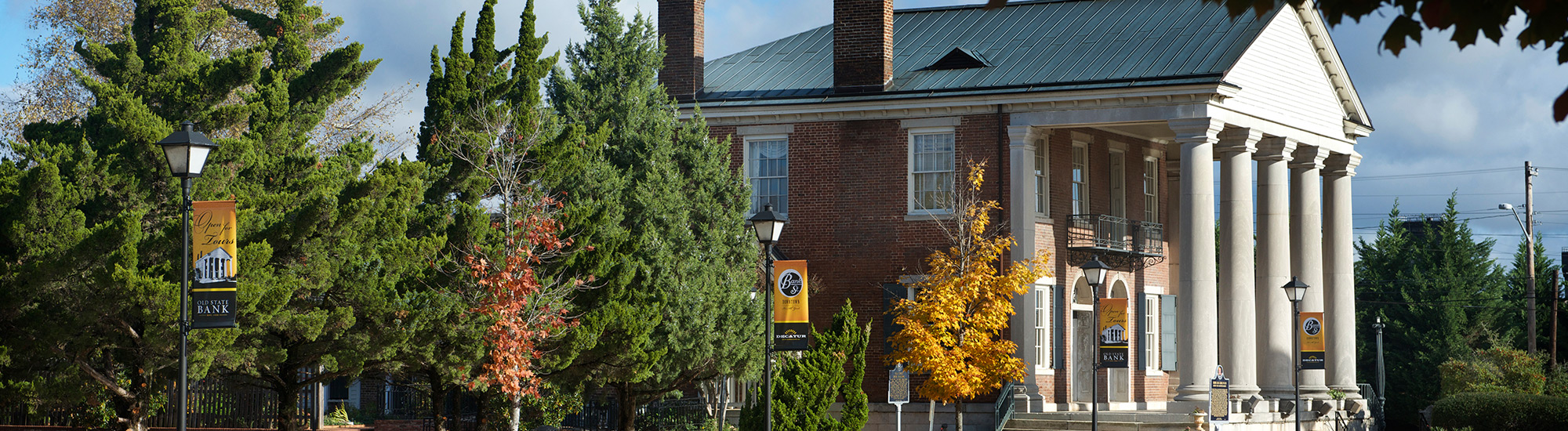
Built over 180 years ago, the Old State Bank in Decatur stands today as a reminder of Decatur’s rich history. Completed in 1834, the building originally housed the Tennessee Valley branch of the Bank of the State of Alabama. After the failure of the state bank, it saw many varied uses and even survived the destruction of Decatur during the Civil War. Throughout an often-turbulent history, the Old Bank has stood sentinel over the growing city of Decatur.
Old State Bank has been listed on the National Register of Historic Places since 1972. It is considered significant for its architecture, association with politics, commerce, conservation, and woman’s history. The architect of the bank was possibly George Steele, a Virginia-born Huntsville designer who is known to have designed Huntsville’s 1835 State Bank. While the builder of record for the bank is unknown, enslaved labor likely constructed most of the structure, which would have included making the bricks by hand.
Old State Bank is significant for its relationship with two remarkable women – Lelia Seton Wilder Edmundson and Carolyn Cortner Smith. Edmundson lived in the bank for part of her childhood, later inherited it from her uncle, and eventually donated the building to the American Legion. Edmundson owned substantial farm acreage and was known as “Alabama’s Cotton Queen” when she served as the state’s representative to the 1900 Paris Expo. She also participated in experimental programs with the U. S. Department of Agriculture. In 1922 Edmundson ran against Edward B. Almon in a primary for the state’s 8th Congressional representative seat, making her the first woman in the state to run for Congress. Although she lost the primary, she won more than 30% of the vote. Lelia gave Old State Bank to the city, ensuring it would remain a public cultural institution. The city then used funding provided by the Civil Works Administration, to rehabilitate the structure, which needed significant work after having stood a century by that time.
Carolyn Cortner Smith, the first female to practice architecture in Alabama, was responsible for the 1934 rehabilitation of the bank. Smith taught herself architecture during a time when women were not admitted to architecture school. She owned and operated her own lumber mills, named “Carolyn Lumber Mills.” Smith served as the Morgan County lead for the Civil Works Administration’s architectural department. Her work on the highest profile building in the county at that time, the Old State Bank, was reported on by the local newspaper repeatedly.
The National Register nomination for Old State Bank gives more detail on the complex history of this fascinating building. A pod-cast on Carolyn Cortner Smith provides more information on her life.